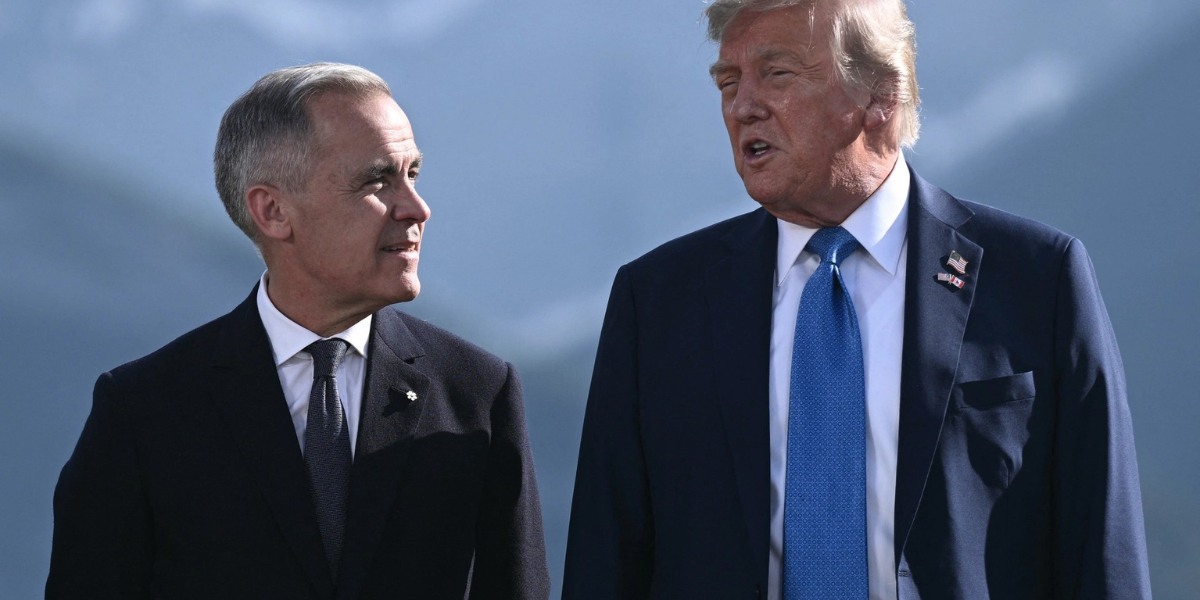
The Trump 50% tariffs on Canada, announced Monday, target a wide range of Canadian goods in response to what his administration calls unfair trade discrimination against American cars, dairy and alcohol. The move marks one of the sharpest escalations yet in Canada-US trade tensions, and it lands with Canadian Prime Minister Mark Carney promising to “intensify” negotiations with Washington in the weeks ahead.
According to the White House, the new duties take effect in 30 days, leaving a narrow window for the two governments to reach an agreement before the tariffs bite.
Trump 50% Tariffs on Canada: What Was Announced
Trump signed three separate proclamations on Monday, each imposing a 50% tariff on a different category of Canadian imports. According to a White House fact sheet, the tariffs cover products “ranging from wine to hockey sticks to cement,” along with a broader set of industrial and consumer goods.
A senior administration official told reporters the 50% rate is the maximum the president can impose under the law being used, and that the tariffs apply to covered goods regardless of whether they would otherwise qualify for duty-free treatment under the existing North American trade agreement.
Why Trump Is Targeting Canada With New Tariffs
The White House says the tariffs are meant to correct what it describes as long-standing discrimination against three specific US industries: automobiles, dairy and alcohol.
On autos, the administration objects to Canadian taxes on US vehicles and parts that fall outside the terms of the US-Mexico-Canada Agreement (USMCA). On dairy, the friction centers on Canada’s supply management system, which restricts foreign imports and imposes steep tariffs , reportedly as high as 300% , on products that exceed set quotas. On alcohol, US officials point to an ongoing boycott of American liquor by most Canadian provinces, which began last year and has become an increasing irritant for US producers.
An administration official said Canada was one of only two US trading partners , alongside China , that chose to retaliate against earlier Trump tariffs rather than negotiate, and argued that Canada “has to be held accountable” as a result.
Key Canadian Exports Spared From the Tariffs
Not all Canadian goods are affected. The White House confirmed that energy products, potash, fish and critical minerals are excluded from the new duties, as are goods already subject to separate tariffs under other trade authorities. Still, the measures reach deep into sectors that had previously been shielded by USMCA, raising the stakes for Canadian exporters and US companies that rely on cross-border supply chains.
US-Canada Trade Tensions Have Been Escalating
Trade relations between the two countries have been under strain since Trump returned to office in January 2025 and launched a broad program of global tariffs. Canada was among the few countries to hit back, placing roughly C$30 billion in counter-tariffs on US goods, though Carney later scaled some of those back.
The two countries already had layers of tariffs in place before Monday’s announcement, including US duties on Canadian steel, aluminum, copper and softwood lumber, as well as Canadian counter-tariffs on American steel, aluminum and vehicles. The latest action adds a new, steeper layer on top of that existing friction.
The announcement also follows recent tension over wildfire smoke drifting from Canada into US cities, an issue Trump has previously raised as a grievance, though it was not cited as a formal justification for Monday’s tariffs.
What the New Tariffs Mean for North American Trade
Monday’s proclamations rely on Section 338 of the Tariff Act of 1930, a rarely invoked provision that allows a president to impose tariffs of up to 50% on a country found to be discriminating against US commerce. Trade law experts note the authority has gone essentially unused for decades and has not been tested by contemporary courts, raising the possibility of legal challenges similar to those that struck down earlier Trump tariffs.
Earlier this year, the US Supreme Court ruled that many of Trump’s global tariffs, imposed under the International Emergency Economic Powers Act, exceeded presidential authority. In response, the administration has turned to alternative legal tools, including Section 301 measures against countries such as Brazil, and now Section 338 against Canada.
Economists have warned the approach carries broader risk. Some trade analysts describe the Trump 50% tariffs on Canada as a significant departure from the cooperative framework Trump himself negotiated in the 2018 USMCA deal, while others caution it could inject uncertainty into global trade well beyond Canada. As Washington’s tariff disputes ripple outward, other countries are pursuing their own trade realignments , for related coverage, see our report on the Amazon India-Texprocil trade partnership.
What Happens Next for Canada-US Trade Relations
Carney responded to the tariffs in a statement, calling them part of a pattern of unilateral US trade actions that conflict with USMCA, and pointed to broader concerns about Canadian sovereignty. Canada has separately been highlighting its efforts to diversify trade relationships beyond the United States.
Ontario Premier Doug Ford said on social media that Canada should respond “tariff for tariff, dollar for dollar” if the new duties go into effect. Business groups on both sides of the border, including the Canadian Chamber of Commerce and the US Distilled Spirits Council, have urged officials to use the 30-day window to reach a resolution rather than allow the dispute to escalate further.
For now, formal negotiations have not resumed, though US officials say discussions between the two sides have continued on a less formal basis. With the Trump 50% tariffs on Canada not taking effect for a month, both governments have time to seek a deal , though it remains uncertain whether Monday’s escalation will accelerate talks or harden positions on both sides.

I am Rukaiya Kadiwala, an experienced News Content Writer with 6+ years of expertise in hospitality, travel, hotel, restaurant, business, and lifestyle news. Skilled in writing, research, fact-checking, headline creation, and digital publishing, I create accurate, engaging, and high-quality content that informs and attracts readers worldwide.