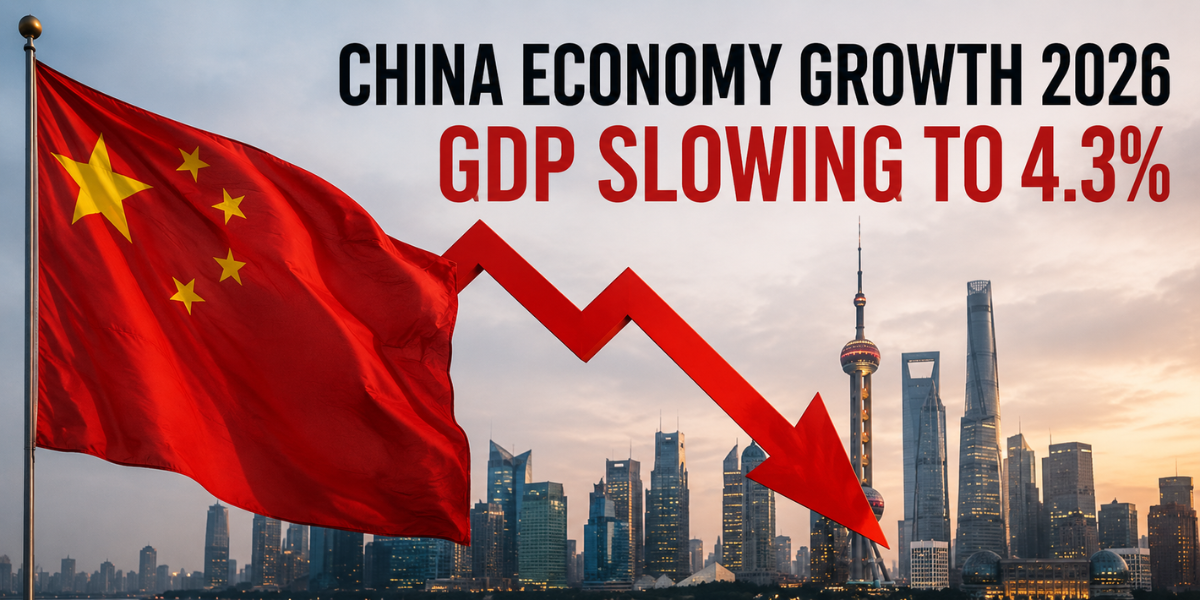
China economy growth 2026 figures came in weaker than expected for the second quarter, with GDP expanding by just 4.3% between April and June. The reading fell short of Beijing’s official target range of 4.5% to 5% and ranks among the slowest quarterly results since China began publishing regular GDP data in the early 1990s. For global investors, policymakers, and businesses that depend on Chinese demand, this slowdown carries real weight. In this article, readers will learn what caused the dip, how exports are propping up the economy, what experts think comes next, and what to watch in the months ahead.
Key Takeaways
- China’s Q2 GDP grew 4.3%, below expectations.
- Exports surged 27%, led by strong overseas demand.
- Domestic demand and investment remained weak.
- Markets are awaiting possible stimulus measures.
Table of Contents
- China Economy Growth 2026: GDP Slows to 4.3%
- Exports Continue to Drive China’s Economy
- Weak Domestic Demand Remains a Challenge
- Why Economists Are Concerned
- Global Risks Facing China’s Economy
- What Could Happen Next?
- Key Economic Figures
- Key Highlights
- Conclusion
China Economy Growth 2026: GDP Slows to 4.3%
The National Bureau of Statistics of China released the figures on Wednesday, confirming that the world’s second-largest economy grew slower than officials had hoped. The only weaker quarter in recent years came at the end of 2022, when strict Covid-19 restrictions were still in place.
Even so, growth for the first half of the year averaged 4.7%, which technically remains within Beijing’s target band. That figure may ease some pressure on policymakers to act immediately.
Exports Continue to Drive China’s Economy
While domestic activity cooled, trade with the rest of the world told a different story. Customs data for June showed outbound shipments jumping by 27% compared with a year earlier.
Car exports were a standout, topping one million units in a single month for the first time. This split highlights how dependent the Chinese economy has become on selling goods abroad rather than growing through spending at home.
- Exports rose 27% year-on-year in June.
- Monthly car exports crossed one million units.
- Overseas demand continues to offset domestic weakness.
Weak Domestic Demand Remains a Challenge
Domestic figures painted a more troubling picture. Vehicle sales inside China dropped by more than 16%, even as retail sales excluding cars rose a modest 3%.
Economists say that modest retail growth is not enough on its own. Fixed-asset investment, which covers infrastructure such as roads and bridges, fell by more than 4% between January and May, a decline rarely seen in the country’s modern history.
Property Sector Adds to the Strain
Real estate and construction, once major engines of Chinese growth, have continued to contract. This weakness in property investment has added further pressure on local governments, which historically relied on land sales and construction activity for revenue.
Why Economists Are Concerned
Li Daokui, an economics professor at Tsinghua University and an adviser to senior Beijing leadership, warned that local governments have shifted from being drivers of growth to becoming obstacles. He pointed to the scale of the recent investment decline as historically unusual, comparing it to only two other periods since 1949.
According to Li, unemployment and falling investment need urgent attention, since failing to address them could put China’s broader economic goals at risk.
Global Risks Facing China’s Economy
Beyond domestic issues, external pressures are building. The US-China trade relationship remains in a fragile truce, and Beijing is wary that tariffs could return once the current pause expires in November.
Tensions tied to the US-Israel conflict with Iran also threaten to dampen global demand for Chinese goods. China has so far avoided major disruption thanks to its energy stockpiles, but a broader global slowdown would hit its export-driven model hard.
What Could Happen Next?
Attention now turns to a gathering of top Communist Party officials later this month, where analysts will watch closely for any hints of fresh stimulus. Since first-half growth remains within target, however, Beijing may hold off on aggressive intervention for now.
- Possible new stimulus measures.
- Communist Party policy meeting later this month.
- Ongoing uncertainty over US-China tariffs.
- Calls for reforms to boost consumer spending.
Key Economic Figures
| Indicator | Data |
|---|---|
| GDP Growth (Q2) | 4.3% |
| Government Target | 4.5–5% |
| Export Growth | 27% |
| Vehicle Sales | -16% |
| Retail Sales | +3% |
| First Half Growth | 4.7% |
Key Highlights
- China’s GDP grew 4.3% in Q2 2026.
- Growth missed the government’s target range.
- Exports surged despite weaker domestic demand.
- Vehicle sales fell sharply.
- Economists called for stronger stimulus measures.
- Fixed-asset investment continued to weaken.
- Trade tensions remain a major concern.
- Policymakers are expected to discuss new economic support.
Conclusion
In short, China economy growth 2026 data shows a country leaning heavily on exports while struggling to revive spending and investment at home. Strong overseas shipments, led by record car exports, have masked deeper cracks in the property sector and consumer confidence. This story matters globally because China’s performance influences trade flows, commodity prices, and supply chains far beyond its borders. Economists and investors will now closely watch Beijing’s next policy decisions to see whether new stimulus measures can revive domestic demand and support economic growth.
Related: Meta Canada Data Center
Official Source: National Bureau of Statistics of China

I am Rukaiya Kadiwala, an experienced News Content Writer with 6+ years of expertise in hospitality, travel, hotel, restaurant, business, and lifestyle news. Skilled in writing, research, fact-checking, headline creation, and digital publishing, I create accurate, engaging, and high-quality content that informs and attracts readers worldwide.