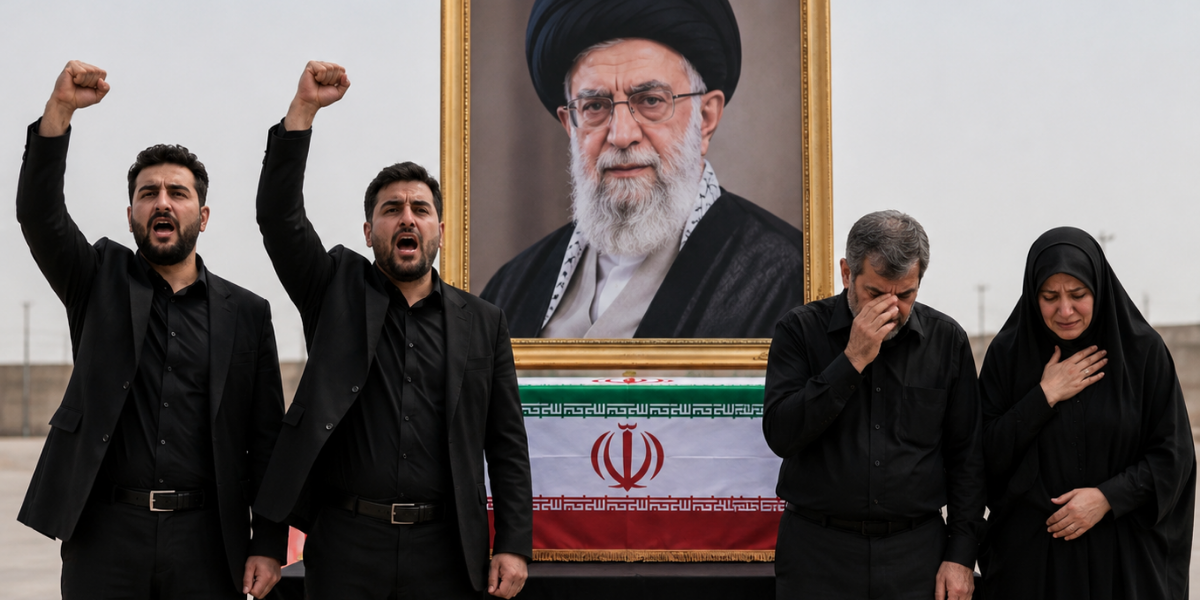
Iran began a week of mass funeral ceremonies for assassinated former supreme leader Ali Khamenei on the weekend, with mourners in Tehran openly calling for the killing of United States President Donald Trump.
The Khamenei funeral, held at the Imam Khomeini Grand Mosalla in Tehran, drew massive crowds who waved red flags symbolizing vengeance and carried images of their slain leader. Khamenei, along with several family members, was killed on February 28 during the opening day of the US and Israeli war on Iran. The funeral had been postponed because of the conflict.
Poet’s Remarks Spark Cheers at Farewell Ceremony
During a poetry recitation ahead of the prayer service, poet Mohammad Rasouli told the crowd that avenging Khamenei’s death was now their responsibility, and questioned aloud why Trump was still alive. The remark, which organizers had approved in advance, drew a mostly enthusiastic response from mourners.
Officials framed the gathering around themes of grief and retaliation. Mohammed Bagher Zolghadr, secretary of Iran’s national security council, said the crowd’s message combined resistance toward Iran’s enemies with a demand for retribution over Khamenei’s death.
Among the messages mourners chalked onto the ceremony stage, one written in English simply read “Kill Trump.”
Mojtaba Khamenei Remains Out of Public View
Ali Khamenei’s son Mojtaba, named as Iran’s new supreme leader roughly ten days after his father’s death, was again absent from the funeral proceedings on Sunday. His three brothers stood beside their father’s coffin, but Mojtaba has not appeared publicly or released any audio statement in three months, and he skipped his own wife’s funeral service last week.
Iranian officials say Mojtaba sustained injuries during the February attacks, though they maintain he suffered no permanent disfigurement or amputation. Security concerns are widely believed to be behind his continued absence from public events.
Religious Symbolism Anchors the Week of Mourning
According to Al Jazeera’s reporting on the ceremonies, Iranian authorities have built the funeral around heavy religious and political imagery designed to project unity at home and across the region. The official slogan for the events translates to “We must rise,” drawn from a Quranic verse urging believers to stand up for a divine cause.
A recurring image throughout the ceremonies shows Khamenei’s clenched fist rendered in red and black, a reference to a message attributed to Mojtaba describing his father’s undamaged hand as clenched shortly before his death. The colour scheme is meant to evoke grief, martyrdom and calls for revenge together.
A large banner unfurled over the Grand Mosalla invokes the seventh-century killing of Hussein, the Prophet Muhammad’s grandson, at Karbala, drawing a direct line between that historical event and calls for retaliation against the US and Israel today.
The route planned for Khamenei’s remains, from Tehran to Qom, then to Najaf and Karbala in Iraq, and finally to his birthplace of Mashhad, touches several sites central to Shia religious and political history.
A Divided Response Inside Iran
Not everyone in Tehran took part in the mourning. In the city’s wealthier northern districts, some residents continued about normal life, dining at cafes without head coverings, a scene culturally distant from the mass ceremonies elsewhere in the capital. The contrast highlighted the uneven economic hardship many Iranians have faced since the war.
Some attendees travelled long distances on limited means to take part, sleeping in makeshift dormitories set up in schools and offices near the mosque. Community stalls offered food and drink to visitors throughout the multi-day event.
Iran has not announced how, or whether, it intends to act on the calls for revenge voiced at the funeral. Officials have pointed to Iran’s long-term goal of pushing US forces out of the region as its broader response strategy following past assassinations of senior figures.

I am Rukaiya Kadiwala, an experienced News Content Writer with 6+ years of expertise in hospitality, travel, hotel, restaurant, business, and lifestyle news. Skilled in writing, research, fact-checking, headline creation, and digital publishing, I create accurate, engaging, and high-quality content that informs and attracts readers worldwide.