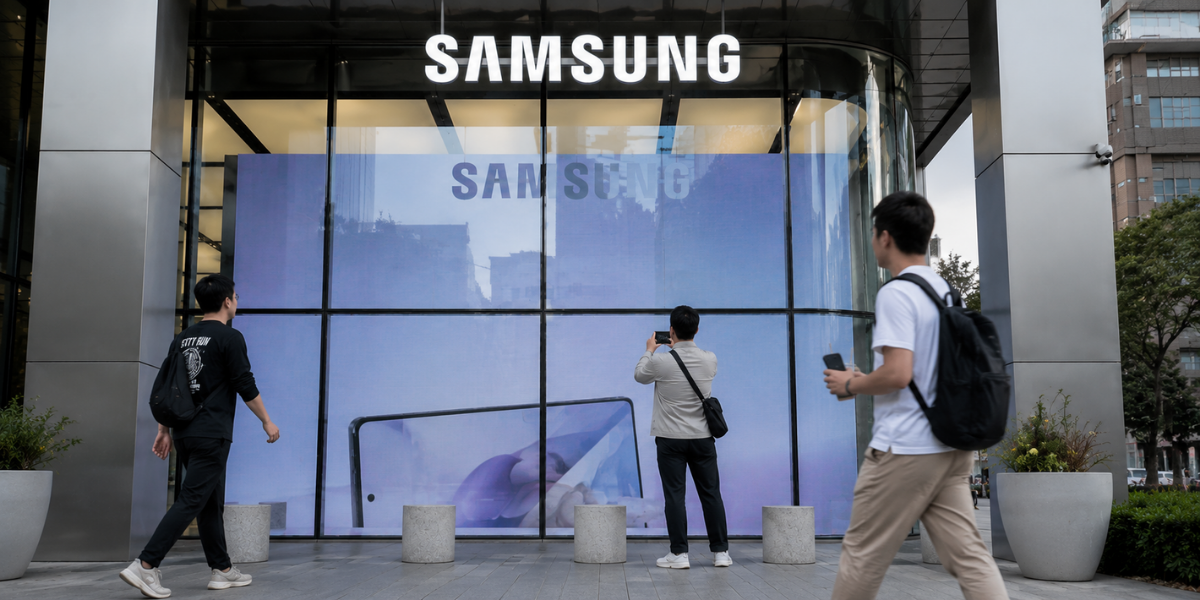
Samsung AI profit surged sharply in the second quarter, with the South Korean technology giant reporting a record operating profit of 89.5 trillion won (€54 billion) for the April-to-June period, according to Euronews. The figure marked a 56% increase from the previous quarter and was more than 19 times higher than the same period a year earlier. Despite the record earnings, Samsung’s stock (005930.KS) traded down 0.72% following the announcement, reflecting broader volatility in the South Korean market this week.
According to rounded figures published by Samsung, operating profit from its semiconductor division jumped to 89.2 trillion won (€53.8 billion), representing 223 times the division’s profit of 0.4 trillion won (€241 million) recorded a year earlier. The semiconductor division benefited from rising chip prices, driven by demand for AI servers and increased shipments of advanced high-bandwidth memory chips used to power AI applications, Euronews reported.
That strength in the chip business offset an operating loss recorded in Samsung’s mobile, television and home appliances division, which the company attributed in part to rising component costs. Samsung’s quarterly revenue rose 28% from the previous quarter and 130% year-on-year, reaching an unprecedented 171.5 trillion won (€103.5 billion), according to the report.
Samsung said in a statement that it expects demand for its memory products to remain strong in the second half of the year, driven by continued expansion of AI infrastructure and broader adoption of agentic AI. The company added that demand for server chips is expected to accelerate further, keeping the market in a state of undersupply, Euronews reported. Further financial disclosures are available through Samsung Electronics Investor Relations.
Samsung Electronics released its results a day after rival SK Hynix announced its own record quarterly revenue and operating profit, as the world’s two largest memory chip manufacturers continue to benefit from the artificial intelligence boom, according to Euronews.
Both Samsung and SK Hynix have positioned themselves as central beneficiaries of the global race to build out AI infrastructure, with their advanced memory chips serving as a critical component in servers used to train and run AI systems. According to Euronews, the surge in profits at both companies reflects the scale of investment currently flowing into AI hardware globally, even as questions remain about how long the current pace of demand can be sustained. The two companies together dominate the global high-bandwidth memory market that has become central to AI server production.
Despite the surge in profits, shares of both companies fell sharply this week on South Korea’s stock market, which the report described as particularly volatile due to retail investors often driving sharp price swings. The declines came amid investor concerns over the companies’ plans for substantial spending to expand production capacity, as well as the prospect of increased competition from Chinese manufacturers, Euronews reported.
Kim Jaejune, executive vice president of Samsung’s memory division, said the company expects the gap between chip supply and demand to widen further in 2027. He added that the shortage is expected to persist into 2028, according to Euronews. The broader momentum in AI-linked corporate earnings has echoed across other sectors as well, including consumer-facing companies such as those detailed in Nike’s online sales growth in China.
No further details on Samsung’s specific capital expenditure plans, or on the precise scale of anticipated competition from Chinese chipmakers, were included in the available reporting, though Euronews noted that concerns over both factors contributed to the decline in Samsung and SK Hynix shares this week despite record earnings. The Samsung AI profit reflects strong global demand for AI semiconductors and advanced memory chips, with the company expecting supply shortages to continue into 2028.

I am Rukaiya Kadiwala, an experienced News Content Writer with 6+ years of expertise in hospitality, travel, hotel, restaurant, business, and lifestyle news. Skilled in writing, research, fact-checking, headline creation, and digital publishing, I create accurate, engaging, and high-quality content that informs and attracts readers worldwide.