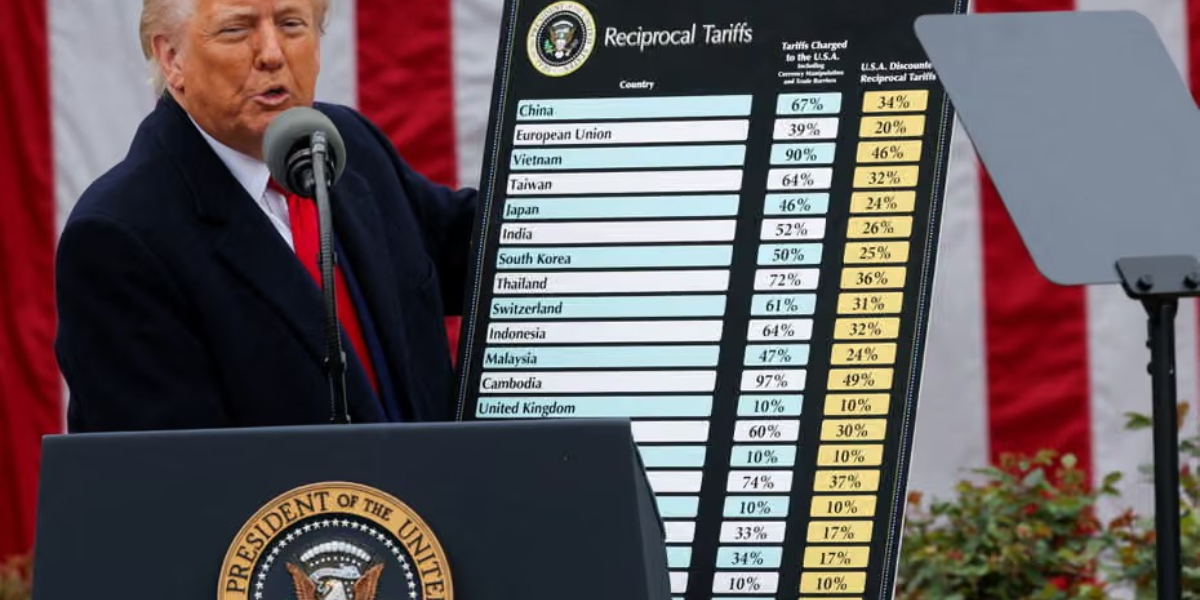

Featured Image: [Trump speaking with Reciprocal Tariffs chart] Alt Text: “Trump Reciprocal Tariffs chart amid Canada Trump Tariffs dispute over forced labour duties”
Canada Trump Tariffs have become the focus of a new trade dispute after the Canadian government formally argued there is no legal basis for proposed US tariffs linked to forced labour concerns. In a submission to the United States Trade Representative (USTR), Canada said its existing laws and newly introduced legislation already address forced labour in supply chains and should protect Canadian goods from additional duties.
Table of Contents
- Why Canada Opposes the Proposed Tariffs
- What Are the Section 301 Tariffs?
- Canada’s New Forced Labour Legislation
- Key Highlights
- Industry Groups Back Canada’s Position
- Why This Matters to Canada
- Canada Trump Tariffs: Key Developments
- What’s Next for Canada Trump Tariffs?
- Conclusion
- Official Sources
Why Canada Opposes the Proposed Tariffs
Ottawa’s written submission to the USTR argues that Canada’s current legal framework, combined with new supply-chain transparency measures and fresh forced-labour import legislation, already meets the standard Washington is asking for. The government told US officials it remains committed to working with American counterparts to root out forced labour from cross-border supply chains, and that this ongoing cooperation , paired with the country’s existing import ban , leaves no grounds for fresh Section 301 duties on Canadian goods.
The submission was one of more than 1,500 filed by governments and industry groups ahead of a three-day Washington hearing on President Trump’s use of Section 301 to reshape US trade policy.
What Are the Section 301 Tariffs?
US Trade Representative Jamieson Greer announced in March that his office was opening trade investigations into roughly 60 countries, including Canada. Greer indicated that Canada, Mexico, the United Kingdom, and several other nations could face a 10% duty for not doing enough to enforce forced-labour bans, while dozens of countries with partial or no such bans could see a 12.5% duty.
The probe follows the US Supreme Court’s decision striking down the tariff authority Trump had relied on for his earlier “Liberation Day” tariffs and fentanyl-related duties on Canada, Mexico, and China. In response, Trump introduced a temporary 10% worldwide tariff under a different section of the same trade law , one set to expire at the end of July unless Congress acts to extend it.
Canada’s New Forced Labour Legislation
Canada already requires companies to file annual reports on forced labour risks in their supply chains, but Ottawa introduced Bill C-35 last month to strengthen enforcement. The bill would:
- Create a public list of products linked to forced labour in specific regions, drawn from intelligence gathered by embassies and other authorities
- Require importers to prove that goods from listed regions were not produced through forced labour
- Reinforce existing supply-chain transparency and reporting obligations
Key Highlights
- Canada formally rejects the proposed US tariffs tied to forced labour enforcement
- Ottawa argues its current laws already combat forced labour effectively
- Bill C-35 would strengthen enforcement through a public product list and importer proof requirements
- Canadian business groups oppose broad tariffs, favoring targeted cooperation instead
- More than 1,500 submissions were filed with the USTR ahead of the hearing
- CUSMA exemptions remain a central issue in the dispute
Industry Groups Back Canada’s Position
Canadian business and trade organizations echoed the government’s stance in their own USTR filings. The Canadian Chamber of Commerce urged the trade office to evaluate Canada separately, pause the proposed 10% tariff while enforcement reforms take effect, and pursue targeted bilateral cooperation rather than broad country-wide measures.
The Canadian Federation of Agriculture warned that tariffs could disrupt a highly integrated agricultural trading relationship, raising input costs and squeezing competitiveness given how often farm products cross the border during processing. Meanwhile, the National Foreign Trade Council , representing US businesses , argued that broad tariffs are a blunt tool unlikely to eliminate forced labour, since they would penalize companies that have already invested in cleaning up their supply chains.
Why This Matters to Canada
A new round of duties could ripple across several sectors of the Canadian economy:
- Exports: Additional tariffs would raise costs for Canadian goods entering the US market
- Manufacturing: Cross-border supply chains for autos, steel, and aluminum are already affected by separate US duties
- Agriculture: Farm products that cross the border multiple times during processing face compounding cost pressure
- Trade relations: The dispute adds friction to an already strained Canada-US trade relationship
- CUSMA-reliant businesses: Many Canadian submissions emphasized that CUSMA exemptions should stay in place regardless of the investigation’s outcome
Canada Trump Tariffs: Key Developments
The dispute has moved quickly since Greer’s March announcement of investigations into roughly 60 countries. Ottawa’s Monday submission, Bill C-35’s introduction last month, and more than 1,500 filings from governments and industry groups all landed within weeks of this week’s Washington hearing ,signaling how urgently both sides want the Section 301 question resolved before Trump’s temporary worldwide tariffs expire at the end of July.
What’s Next for Canada Trump Tariffs?
The USTR is now reviewing the submissions following this week’s public hearings, and no final decision has been announced. Canada says it will continue engaging with Washington on forced labour enforcement while pressing its case that no additional tariffs are warranted.
Conclusion
Canada maintains that its forced labour laws already meet a high standard, and argues that new US tariffs under Section 301 are unnecessary given existing protections and Bill C-35’s added enforcement measures. How the USTR responds could shape Canada-US trade relations in the months ahead, particularly for industries operating under CUSMA.
Also Read: Iran Khamenei Funeral: Trump’s Reaction and Death Chants
Official Sources:
United States Trade Representative (USTR)

I am Rukaiya Kadiwala, an experienced News Content Writer with 6+ years of expertise in hospitality, travel, hotel, restaurant, business, and lifestyle news. Skilled in writing, research, fact-checking, headline creation, and digital publishing, I create accurate, engaging, and high-quality content that informs and attracts readers worldwide.