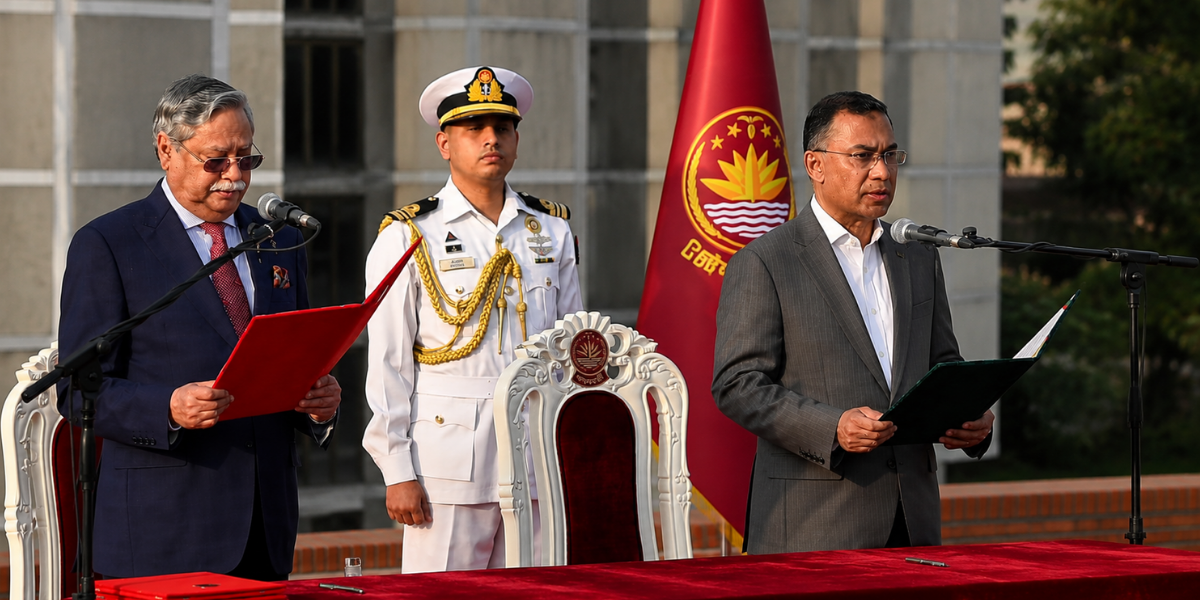
Bangladesh President Mohammed Shahabuddin resigns, citing serious health issues, according to a statement released by his office on Friday. Shahabuddin, 76, has held the largely ceremonial post since April 2023 and is a former ally of ousted Prime Minister Sheikh Hasina, whose government was toppled by a student-led uprising in August 2024.
In a letter to Parliament Speaker Hafiz Uddin Ahmed, Shahabuddin said he was “seriously ill” and therefore unable to continue performing his constitutional duties, according to Al Jazeera, which cited the letter. Ahmed confirmed he had accepted the resignation, the Associated Press reported. Shahabuddin’s office, the Bangabhaban, formally released the statement confirming his departure.
Shahabuddin’s press secretary said in a statement that recent medical examinations had diagnosed the president with a condition known as Autonomic Neuropathy, which causes him to occasionally experience momentary loss of consciousness. Presidential spokesperson Sarwar Alam said the resignation takes effect once the signed letter is submitted to the speaker, as required under the constitution, according to Al Jazeera.
The speaker of the Jatiya Sangsad, Bangladesh’s national parliament, will carry out the duties of the presidency until a successor is elected, the statement said. Under the constitution, a new president must be chosen within 90 days, Al Jazeera reported.
Shahabuddin’s term had been due to run until 2028. His resignation comes two years ahead of schedule and follows what Al Jazeera described as rising pressure from opposition parties for him to step down.
Reuters had reported on Thursday, a day before the announcement, that Shahabuddin was expected to resign. The move leaves Hasina, who is living in exile in India’s capital, New Delhi, without allies in high office roughly five months before her planned return to Bangladesh, Reuters reported.
As head of state, Shahabuddin serves as commander-in-chief of the armed forces, though executive power in the country of 173 million people rests with the prime minister and cabinet. His role has largely been ceremonial throughout a tenure that spanned the volatile period following Hasina’s ouster, including the formation of a caretaker government in the days that followed.
According to The Daily Star, a Dhaka-based newspaper cited by Al Jazeera, the resignation comes amid media reports that Shahabuddin spoke by phone with Hasina during a visit to the United Kingdom for medical treatment in May. He travelled to London on May 9 and returned on May 18, according to Al Jazeera. Shahabuddin has denied the report. Asked by The Daily Star about the reason for his resignation, he said only that he was “suffering from various health complications” and had “nothing more to add at this moment.”
The resignation is also expected to draw attention to Bangladesh’s political transition and the constitutional process for selecting a new head of state. With the speaker of parliament temporarily taking over presidential duties, political parties are likely to focus on the process of choosing Shahabuddin’s successor. Although the presidency carries limited executive authority, the position remains constitutionally important, particularly during periods of political uncertainty. Shahabuddin’s departure comes at a sensitive time for Bangladesh, as the country continues to deal with the political consequences of the 2024 uprising and changes in its governing structure.
The president’s resignation also comes as Bangladesh faces continued political uncertainty surrounding the future of the Awami League and Sheikh Hasina. Hasina’s expected return has added further attention to developments in Dhaka, while her supporters and political opponents remain divided over the country’s political direction. The next presidential appointment could therefore become an important development as Bangladesh moves through its current transition. For now, the speaker of parliament is expected to perform the president’s duties until the constitutional process for electing a new president is completed.
Hasina’s Awami League party remains banned in Bangladesh, and many of its leaders and activists have been jailed or gone into hiding since the 2024 uprising. Hasina has said she plans to return to the country by December, according to Reuters. Shahabuddin’s departure adds to a string of recent high-profile resignations from senior public posts worldwide, including South Africa’s David Masondo’s resignation as PIC chair.

I am Rukaiya Kadiwala, an experienced News Content Writer with 6+ years of expertise in hospitality, travel, hotel, restaurant, business, and lifestyle news. Skilled in writing, research, fact-checking, headline creation, and digital publishing, I create accurate, engaging, and high-quality content that informs and attracts readers worldwide.